
AI-native is not a headcount decision. It's an architecture decision.
Compliance org charts weren't designed for culture — they were engineered to move information. AI changed that problem. Here's the architecture that solves it.

A few weeks ago I came across a data point that stuck with me.
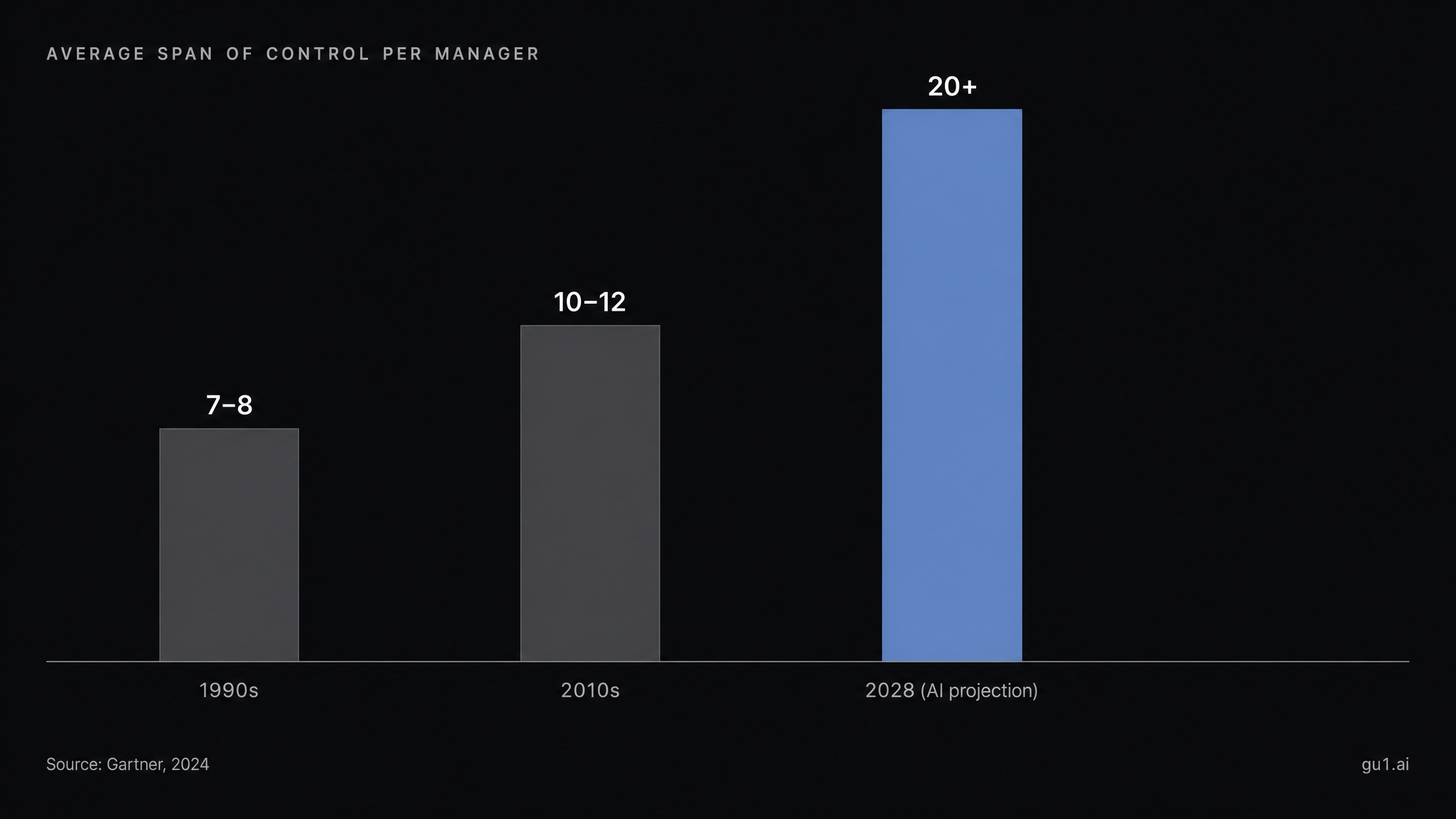
The average manager span of control has expanded consistently over the last thirty years. In the nineties it was around 7–8 people. Over the last decade, between 8 and 12. Gartner projects that by 2028, 56% of CEOs expect to use AI to eliminate entire layers of middle management — not by increasing direct reports, but by changing what needs to exist at all.
It's not that managers got better. It's that the problem that made them necessary at that scale changed in nature.
The org chart is engineering, not culture#
The structures that organize work don't exist because someone designed the ideal org chart. They exist because they solve a specific problem: information is expensive to move.
When a business's context only lives in someone senior enough to have accumulated it, that person has to be in the loop on decisions that matter. When information across different areas doesn't integrate on its own, someone has to integrate it. When the volume of operations exceeds what one person can monitor, you add people.
The org chart is engineering. It's the solution to the problem that information doesn't flow without cost.
When that problem changes, the architecture that solved it stops being optimal.
What I see in financial compliance#
In every financial institution that talks to us, I see the same structure: between 6 and 10 people managing fraud alerts and KYC decisions. Not necessarily because the volume requires it. But because information has to pass through multiple points before anyone can decide with the full picture.
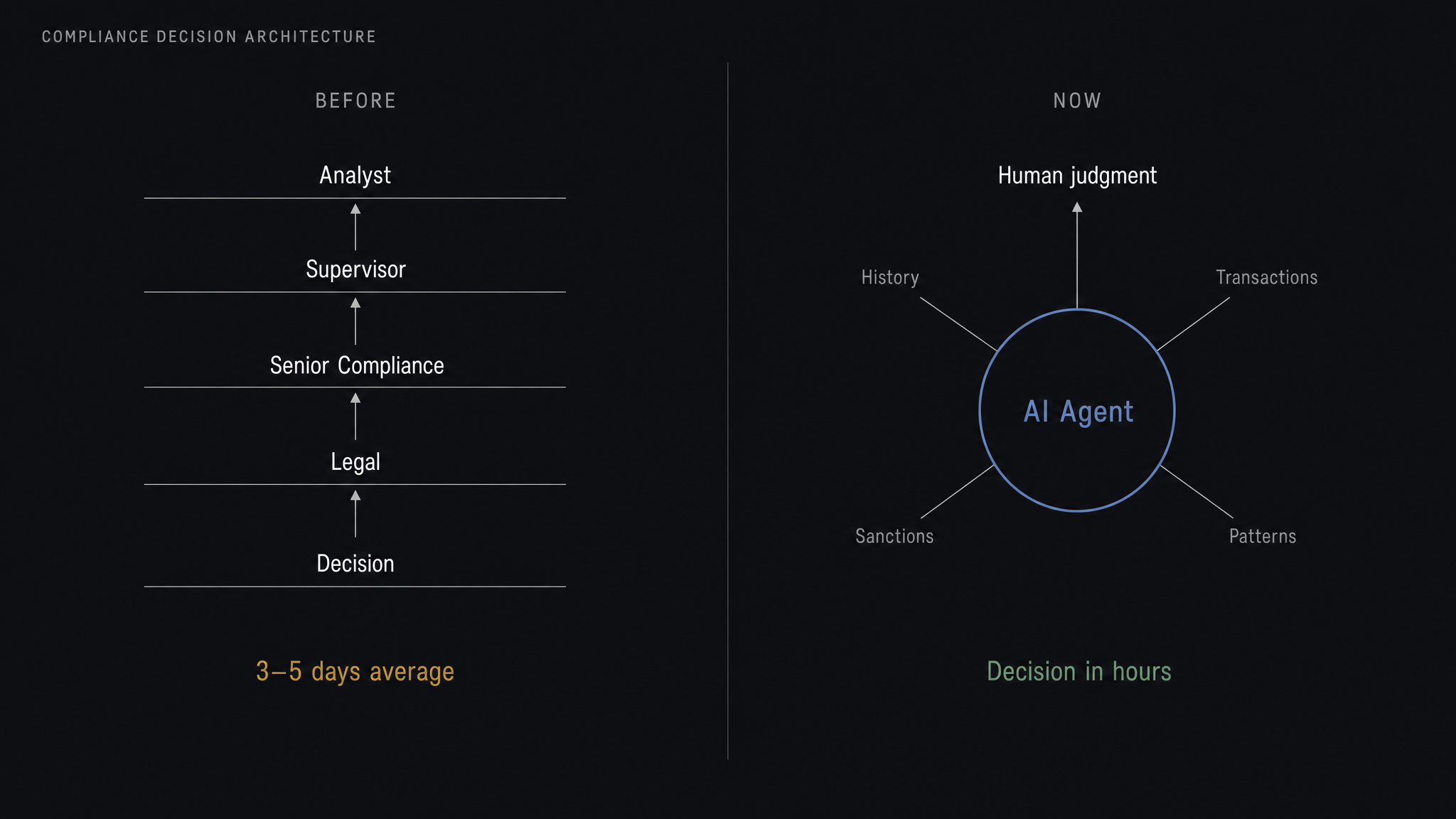
An analyst reviews the alert. Escalates it if it exceeds a threshold. The supervisor adds context from the client's history. If there's ambiguity, it goes to senior compliance. If there's regulatory risk, legal comes in. Five people, three days, for a decision that — with full context from the start — any one of them could have made in the first hour.
The system isn't badly designed. It's designed to operate with expensive information movement.
The problem is that friction has real costs. In time: every escalation adds hours or days to a decision that directly affects customer experience. In consistency: decisions made with partial information and multiple handoffs generate different criteria for similar cases. In operations: the cost difference between manual KYC and AI-native infrastructure is typically in the 60–80% range, and most of that difference is coordination overhead.
In LATAM compliance, where an institution may operate under the BCRA and UIF in Argentina, BCB and COAF in Brazil, CNBV in Mexico, and SFC in Colombia simultaneously, that overhead multiplies. Each jurisdiction has its own rules, deadlines, and reporting formats. Keeping teams current across countries doesn't scale linearly with the business.
What changes when AI operates as a native layer#
When AI operates as infrastructure — not as an assistance tool — the base problem changes.
Context stops being scarce. An agent that monitors transactions in real time, has access to the client's full history, can cross-reference against up-to-the-minute sanctions lists, and holds historical patterns in memory can present a case with a completeness that previously required the accumulated experience of a senior analyst, or the coordination work of several junior analysts.
Decisions don't need to escalate to have the full picture. What was built to compensate for information friction starts to become redundant.
This doesn't mean human judgment disappears. It means it concentrates where it belongs: who decides what counts as a risk signal, what tradeoffs to accept between fraud capture and customer friction, what policies to adjust when regulation changes, what to do when a case has no precedent. That requires judgment that can't be delegated to any system.
What can be delegated is the work of moving information from point to point so someone with judgment can decide. That work, AI can execute with more consistency, more speed, and more traceability than any manual process.
What disappears and what remains#
What disappears isn't the people. It's the architecture that existed because information couldn't flow without cost.
Approval hierarchies that exist so someone with more context can validate what another person already processed. Alignment meetings where information is crossed that should have been integrated from the start. Escalation processes that add time to decisions that already have the necessary information — just distributed across silos that don't talk to each other.
What remains is judgment. Who defines what's acceptable risk for that specific business. Who decides what tradeoffs to take given the current strategy. Who interprets new regulation before the system has it codified. Who responds when a case has no precedent or analogy.
The distinction matters because confusing it leads to two costly errors. One is trying to automate judgment, which produces systems that make correct decisions on average and dangerously incorrect decisions at the edge cases — which in compliance is exactly where you can't afford to be wrong. The other is continuing to operate with architectures built for a problem that no longer has the same nature, paying coordination overhead in contexts where it's no longer needed.
What I learned building this#
When we started deploying agents in production at Gu1, the first problem we faced wasn't technological. It was architectural.
What does the agent do. What does the human do. What happens when the agent is confident but wrong: in compliance, that's the worst type of error because it doesn't surface until the regulator asks. A system that fails loudly is diagnosable. One that fails silently, making slightly incorrect decisions at edge cases, is the kind of problem that shows up in an audit three months later.
The answer we found wasn't philosophical. It was operational: the agent handles context and processing. The human team makes decisions that require judgment. With explicit supervision, auditable logs, well-defined escalation mechanisms, and controls that a bank can audit. Not as a concession, but as part of the design.
Today we have 12 agents in production. One of our clients processes 30 million transactions per month through the platform. The compliance team operating it didn't grow in proportion to the volume. It grew in judgment.
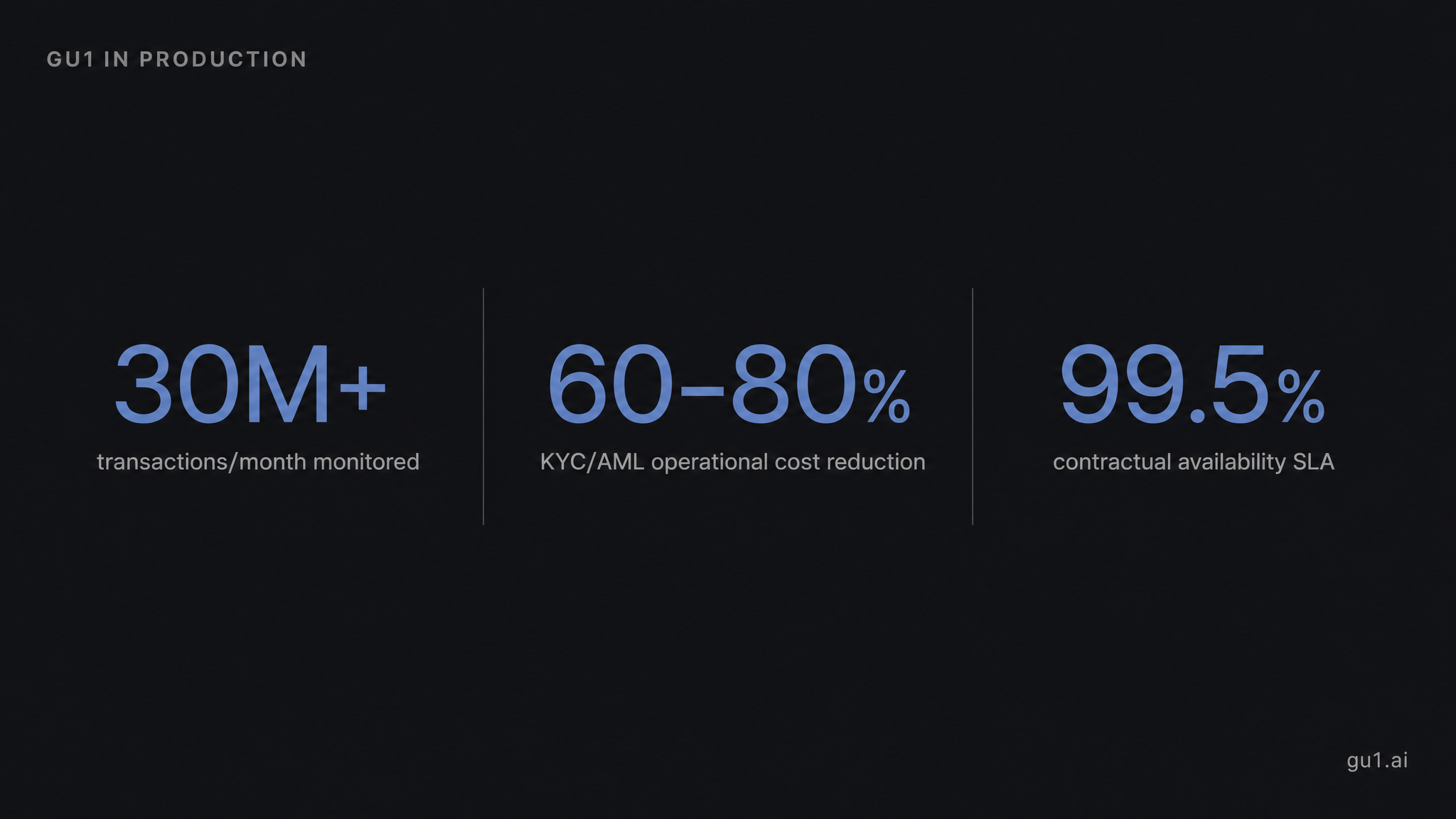
The platform operates under ISO 27001, SOC 2, GDPR, and PCI DSS certifications. The availability SLA we sign in contracts is 99.5%. That's possible because the architecture has 24-hour monitoring and automated response without depending on a human on-call for routine cases.
We didn't build it this way because it's the trend. We built it this way because the financial compliance problem in LATAM — with the regulatory complexity of operating across multiple jurisdictions simultaneously — has a coordination cost that doesn't scale with architectures designed for expensive information movement.
The decision that matters#
The debate about AI in teams usually centers on how many people it replaces. That's the wrong angle.
The relevant question is: what information architecture does your organization have today, and what problem was that architecture designed for?
If you have approval hierarchies that exist because full context only lives with someone of sufficient seniority, and cases escalate because information doesn't flow integrated from the start, the architecture is responding to an information problem. AI-native can change that problem. Not automatically, not without design, not without the right controls. But it changes it.
In financial compliance in LATAM, the combination of regulatory complexity, cost pressure, and volume growth makes this distinction increasingly non-academic. Who scales in the next few years depends in part on whether they built compliance as documentation or as infrastructure.
It's an architecture decision. And like every architecture decision, its consequences show up in two or three years, not in the quarter it's made.
Questions: gu1.ai
Share this post
Get new posts in your inbox
One email when we publish. No spam. Unsubscribe whenever you want.